


-

RM-SGHA10-25 Standard Gain Horn Antenna for 75–110 GHz W-Band Applications
Precision Performance for W-Band RF Measurement At millimeter-wave frequencies, every component in the measurement chain matters. Small impedance mismatches, unstable radiation patterns, or unwanted polarization components can quickly affect test accuracy. The RF MISO RM...Read more -

RM-CPHA1840-12 Circularly Polarized Horn Antenna for 18–40 GHz Millimeter-Wave Testing
As millimeter-wave systems continue to expand across communication, sensing, testing, and airborne platforms, engineers need antennas that can maintain dependable polarization and radiation performance over more than a narrow frequency window. RF MISO’s RM-CPHA1840-12 Ci...Read more -

RM-DCPHA12-10 Dual Circular Polarization Horn Antenna for 1–2 GHz RF Applications
In advanced RF systems, antenna performance is not defined by gain alone. Polarization flexibility, impedance matching, radiation purity, front-to-back isolation, and power-handling capability all influence the reliability of a measurement or communication link. RF MISO’...Read more -

RM-PSA056-3 Right-Hand Circularly Polarized Planar Spiral Antenna for 0.5–6 GHz Applications
Modern RF systems often need to operate across multiple frequency bands while maintaining stable polarization performance in changing installation environments. RF MISO’s RM-PSA056-3 planar spiral antenna is designed to meet these requirements with wideband coverage from...Read more -

RM-SGHA159-10 Standard Gain Horn Antenna for Reliable 4.90–7.05 GHz RF Measurement
Reliable antenna measurements begin with a reference antenna that provides predictable gain, stable matching, and clearly defined radiation characteristics. RF MISO’s RM-SGHA159-10 Standard Gain Horn Antenna is designed for professional RF testing across the 4.90–7.05 GH...Read more -

RM-BDPHA130-15 Broadband Dual Polarized Horn Antenna, 1-30 GHz, 15 dBi Typical Gain
The RM-BDPHA130-15 is a broadband dual polarized horn antenna designed for engineers who need stable wideband performance from 1 GHz to 30 GHz. With a typical gain of 15 dBi and a typical VSWR of 1.5, this antenna is well suited for RF testing, antenna measurement, EMI d...Read more -
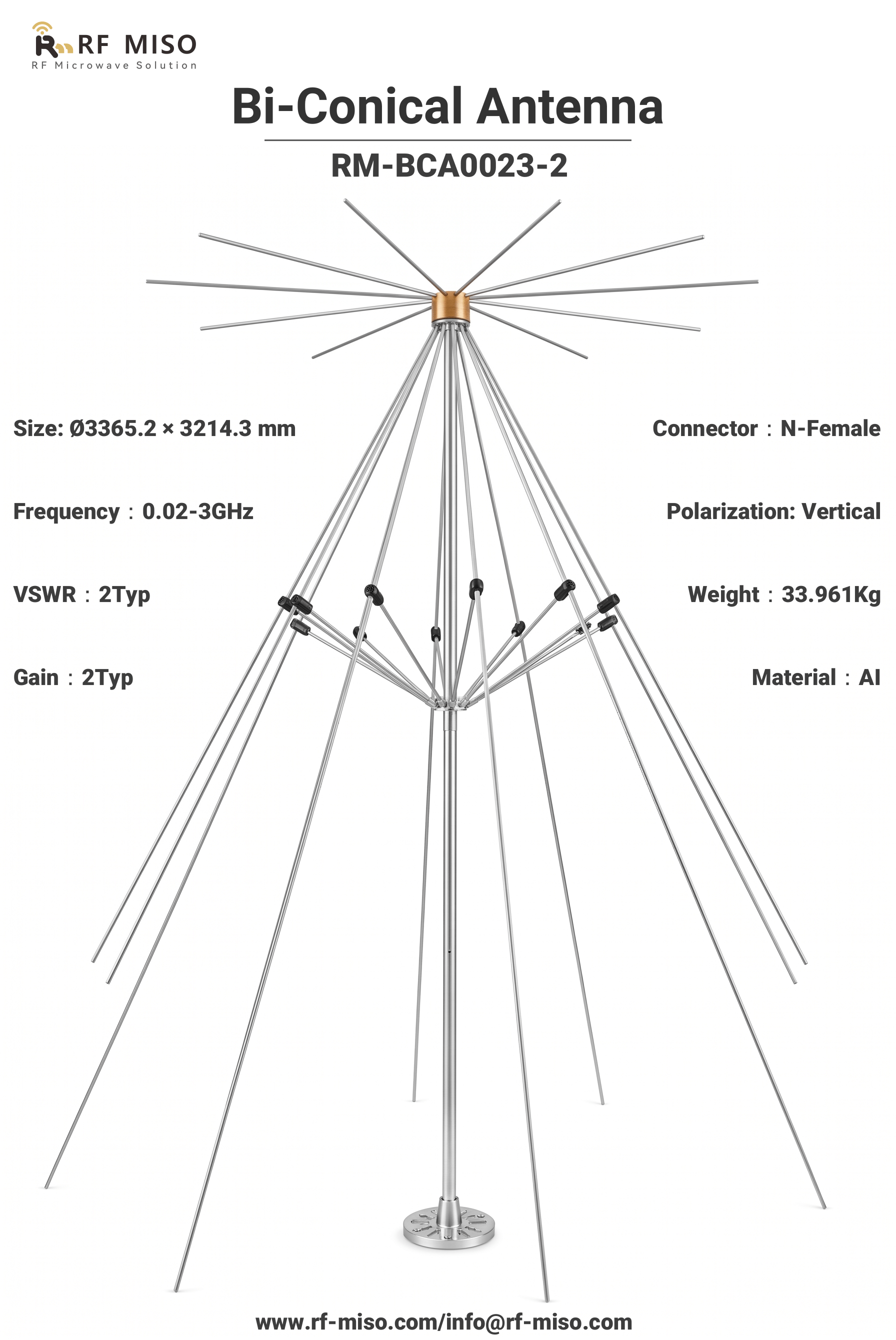
RM-BCA0023-2 Bi-Conical Antenna for 0.02–3 GHz Wideband RF Applications
RF MISO’s RM-BCA0023-2 is a wideband bi-conical antenna designed for RF testing, surveillance, antenna measurement, and system integration applications across the 0.02–3 GHz frequency range. Covering from 20 MHz up to 3 GHz, this antenna provides a practical solution for...Read more -
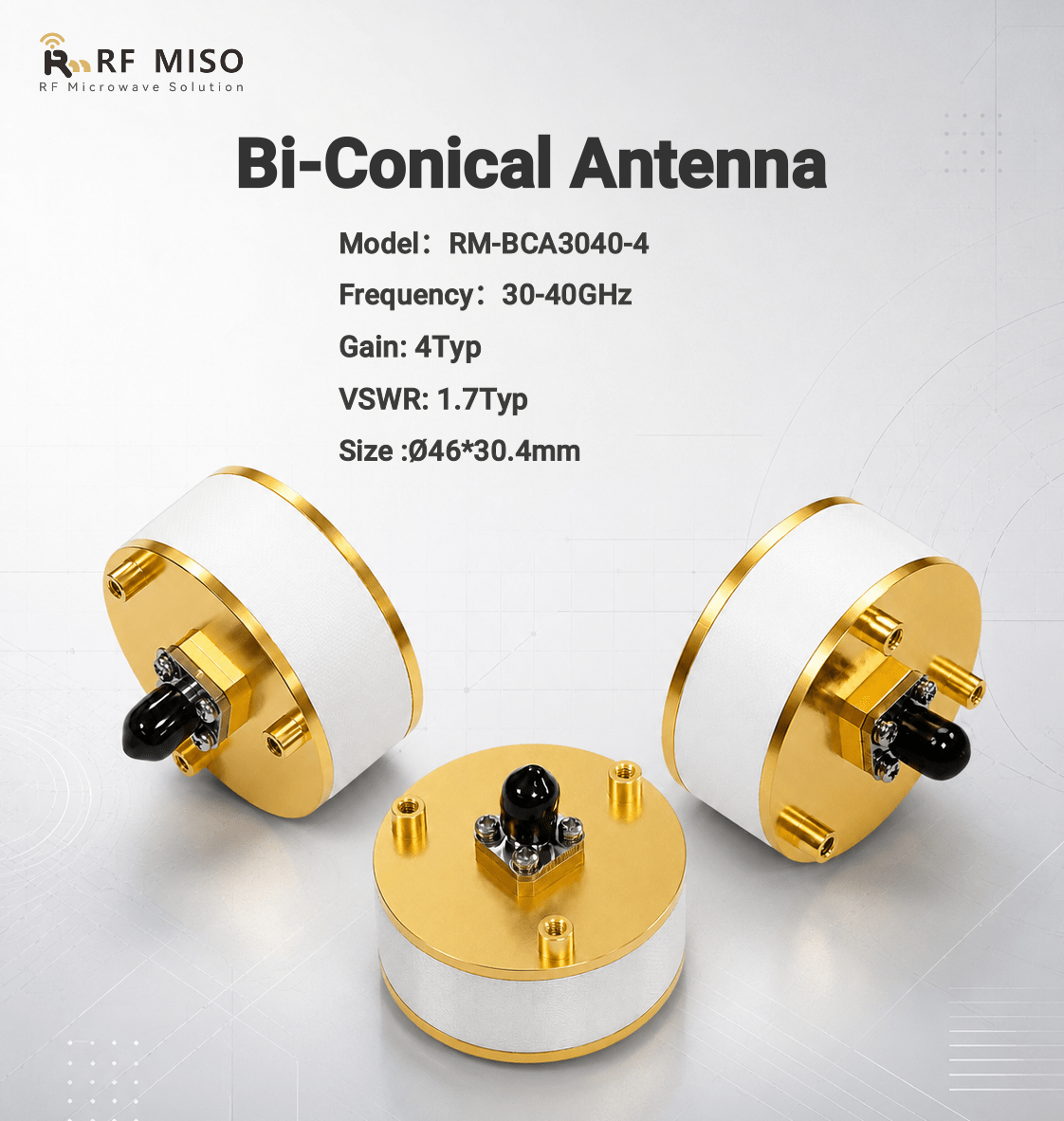
RM-BCA3040-4 Bi-Conical Antenna for 30–40 GHz Millimeter-Wave Testing
When working in the 30–40 GHz millimeter-wave band, engineers often need an antenna that is not only compact and easy to integrate, but also stable enough for repeatable RF testing. RF MISO’s RM-BCA3040-4 Bi-Conical Antenna is designed for this type of high-frequency tes...Read more -

RM-TCR44 Trihedral Corner Reflector for Reliable Passive Reflection and RCS Measurement
The RM-TCR44 from RF MISO is a trihedral corner reflector developed for radar and electromagnetic test environments where stable echo response and dependable mechanical performance are required. Built with a robust aluminum structure, it is designed to deliver long-term ...Read more -

RM-DCPHA218-15: Dual Circular Polarized Horn Antenna for 2–18 GHz Test Systems
In broadband microwave testing and electromagnetic evaluation, antenna selection is often determined not only by frequency coverage, but also by radiation stability, polarization characteristics, and integration flexibility. RM-DCPHA218-15 is designed for such requiremen...Read more -

Broadband Log Periodic Antennas for EMI Detection and RF Measurement
In broadband RF testing and electromagnetic measurement, antenna selection plays an important role in overall test accuracy and efficiency. For engineers working in EMI detection, antenna calibration, pattern measurement, and field-oriented microwave applications, a stab...Read more -

Conical Horn Antenna Solutions for 4–6 GHz and 8–12 GHz RF Testing
In RF testing and microwave measurement, choosing the right antenna can directly affect both efficiency and accuracy. For engineers working in EMI testing, antenna pattern measurement, gain verification, or surveillance-related applications, a stable and broadband conica...Read more


